An Increase in Hemoglobin Affinity for Oxygen Occurs With
This means that hemoglobin holds on to oxygen less tightly thus releasing it more readily to a hungry tissue. What are the four factors that affect binding of oxygen with hemoglobin.

Transport Of Oxygen In The Blood Biology For Majors Ii
Lichtman MA Miller DR Cohen J Waterhouse C Ann Intern Med 1971 Apr744562-8.

. A decrease in the oxygen. An increase in BPG will cause more oxygen to be released from the hemoglobin decreased affinity of oxygen for hemoglobin but if the BPG level decreases less oxygen is released from the hemoglobin an increased affinity of oxygen for hemoglobin. What Factors Affect The Loading And Unloading Of Oxygen From Hemoglobin.
The oxygen-hemoglobin dissociation curve is affected by several factors which are why hemoglobins affinity for oxygen is affected. - When the level of CO2 increases or conditions become acidic or temperature increases hemoglobins affinity for oxygen decreases. Unfortunately these changes were not accompanied by a statistically significant reduction in vaso-occlusive episodes.
In foetal circulation however at a partial oxygen pressure pO2 of 25 mmHg in the umbilical vein the oxygen carrier is type F hemoglobin which has a high oxygen affinity. The patients had either low hemoglobin or red cell production L. Talk to our Chatbot to narrow down your search.
What affects hemoglobin affinity. In blood of 21 anemic patients and 8 normal subjects N three oxygen dissociation curves each were measured at different pH values to calculate Bohr coefficients after acidification with CO2 BCCO2 or fixed acid BCFA and other important parameters of oxygen affinity. This is also a right shift in the oxygen-hemoglobin dissociation curse and is beneficial.
Check the full list of possible causes and conditions now. D An increase in oxygen affinity is known as a shift to the left on the dissociation curve. Thus hemoglobin wants to hold on to oxygen more in high pH tissues with low CO2 levels that are likely to be.
The oxyhemoglobin dissociation curve describes the relationship between arterial oxygen tension partial pressure of oxygen in the arteries P a O 2 and the amount of oxygen bound to hemoglobinthe hemoglobin saturation. Hemoglobin with decreased affinity for oxygen increases the oxygenation of tissues because it gives up oxygen more easily during microcirculation. Several factors influence the binding of oxygen to hemoglobin.
Reduced red cell glycolysis 2 3-diphosphoglycerate and adenosine triphosphate concentration and increased hemoglobin-oxygen affinity caused by hypophosphatemia. 4 An increase in hemoglobin affinity for oxygen occurs with a hyperthermia b from NURS 320 at University of Nevada Las Vegas. These factors include the 1 pH 2 temperature 3 carbon dioxide 4 23-BPG and 5 carbon monoxide.
The tightness with which Hb binds oxygen is called the affinity or the bond strength of Hb. In summary the effect of low pH and high PaCO 2 is to decrease the affinity of haemoglobin for oxygen. This hyperventilation minimizes the potential of the Bohr effect through excess exhalation of carbon dioxide resulting in hypocapnia causing a left shift in the oxygen dissociation and unnecessarily increased oxygen-hemoglobin binding affinity with impaired oxygen release to peripheral tissues including our most vital organs brain heart liver kidney.
Clinical trials in adults and children have shown reduced hemolysis and improved hemoglobin with voxelotor a once daily oral drug that increases the oxygen affinity of hemoglobin maintaining it in the oxygenated state and reducing polymerization and sickling. The affinity of hemoglobin Hb for oxygen increases with decreased metabolic rate. What decreases the affinity of hemoglobin for oxygen.
What factors affect the release of oxygen from oxyhemoglobin. PH 2 temperature 3 carbon dioxide 4 23-BPG and carbon. Which of the following will decrease the affinity of hemoglobin for oxygen.
Decreased pH increased temperature or increased 23-DPG. Possible causes include Acute Hyperventilation. The metabolic regulation of blood pH occurs in.
Elevation in PCO2 is seen with changes in pH. The commonly accepted role for hemoglobin F is limited to. This occurs during exercise increased temperatures increased 23-bisphosphglycerate increased carbon dioxide and decreased pH.
An increase in hemoglobin affinity for oxygen occurs with a. Shift to the left. What disease is characterized by the abnormal hemoglobin S.
The affinity of hemoglobin is affected by temperature hydrogen ions carbon dioxide and intraerythrocytic 23-DPG with all these factors mutually influencing each other. N 11 73 gdl Hb or high erythrocyte. In the left direction oxygen affinity increases and oxygen is more difficult to release.
Increased affinity of oxygen for hemoglobin. Shift to the right. This allows us to unload more oxygen to our tissues.
There are several important factors that affect the affinity of hemoglobin to oxygen as therefore affect the oxygen-hemoglobin dissociation curve. What affects hemoglobin affinity for oxygen. As arterial oxygen tension increases the amount of oxygen loaded onto hemoglobin increases curvilinearly creating a sigmoid- shaped.
A right shift which lowers hemoglobins affinity for oxygen occurs when there is a need for oxygen to be released to surrounding tissue. Temperature pH P CO 2 and 23 diphosphoglycerate 23 DPGIncreasing the temperature of Hb lowers its affinity for O 2 and shifts the oxygen dissociation curve to the right as shown in Figure 3. Increasing pH levels also increases the affinity of oxygen for hemoglobin.
A family of hemoglobin diseases found primarily in people of Mediterranean ancestry is. Hyperthermia does not have an effect on the hemoglobin affinity. Cells with a slower metabolic rate do not require large amounts of oxygen.
This makes sense physiologically because lower pH levels are typically associated with high CO2 levels in oxygen-deprived tissues where hemoglobin would be expected to release oxygen. Hemoglobins affinity for oxygen decreases. If Hb were to give these cells too much oxygen toxicity and cellular damage could result.

Medpro International Critical Care Nursing Post Understanding The Oxyhemoglobin Dissociation Curve By Tom Madayag The Oxyhemoglobin Dissociation Curve Helps Us To Understand The Affinity Of Oxygen To Blood And The Ability
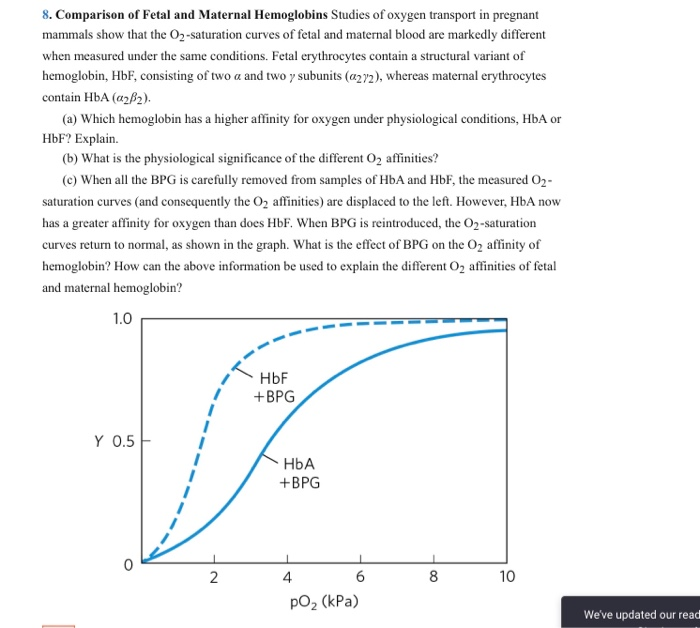
Solved 3 Hemoglobin S Affinity For Oxygen What Is The Chegg Com
What Factors Affect Hemoglobin S Oxygen Affinity Medmastery
No comments for "An Increase in Hemoglobin Affinity for Oxygen Occurs With"
Post a Comment